Heraldry is the practice and study of distinctive armorial identities: how they are designed, described, displayed, recorded, and transmitted. It includes visual art, specialized language, and historical research. A coat of arms is a particular design within that system; heraldry is the wider subject. You can begin by learning to describe one simple shield, then explore the records and conventions that give a historical example its context. You do not need to memorize a dictionary before looking carefully.
What does heraldry mean?
In its narrower visual sense, heraldry concerns arms and related devices. In a broader historical setting, the work of heralds has also involved matters such as genealogy, ceremony, and identifying people or institutions. The exact scope depends on the time, place, and office under discussion.
Calling heraldry an art emphasizes the skill of drawing and composing. Calling it a system emphasizes repeatable descriptions and conventions. Calling it a field of study emphasizes evidence: who bore a design, where it appeared, and how its use changed. These perspectives support one another rather than competing for a single definition.
For a beginner, three questions are enough: What does the image show? How is that design described? What evidence connects it to a bearer? Heraldry becomes easier to understand when you keep those questions separate. A beautiful drawing can be poorly attributed, and a rough historical sketch can still preserve valuable information.
How heraldry developed
The familiar European system of hereditary armorial identities took shape during the twelfth century. It developed in a world of aristocratic households, warfare, tournaments, seals, and public display. Avoid reducing that history to a single invention by one person or one universally accepted moment.
Earlier societies also used identifying symbols, but similarity of shape does not automatically make every ancient emblem an example of medieval heraldry. A shield carrying an image and a repeatable inherited armorial identity are not the same historical claim. Researchers look for context and continuity as well as pictures.
As heraldry developed, its use extended beyond individual armored combatants. Institutions and communities adopted armorial identities, and artists rendered them on buildings, documents, and objects. This helps explain why the subject connects visual design with genealogy, local history, architecture, and collections research.
An introductory timeline is useful, but do not assume every region followed the same sequence. If you study a particular object, use research about its own place and period. The conventions of a later printed handbook may not describe how an earlier artist worked.
Learn six heraldry terms for reading a shield
In heraldry, the field is the background of the shield. A charge is a figure placed on it. An ordinary is a conventional geometric form, such as a broad horizontal band. Tincture is the vocabulary used for colors, metals, and furs. Blazon is the formal verbal description. An emblazonment is an artistic rendering of the described design.
Use those heraldry terms as tools rather than a vocabulary test. If you see a red shield with a silver band, you can describe it accurately in plain language before learning the specialized words. Precision begins with noticing the field, count, placement, and contrast, not with sounding scholarly.
Some everyday words have a narrower meaning in heraldry. Crest refers to a particular element above a helmet, not necessarily the entire decorated shield. Right and left are commonly described from the bearer’s perspective, so they may reverse what the viewer expects. Check orientation before copying an asymmetric design.
Do not guess at an unfamiliar animal posture or object. Compare it with a reliable illustrated reference and record uncertainty if the image is unclear. Good heraldry research allows “not yet identified” rather than forcing every mark into the closest familiar category.
Blazon: how heraldry describes a design
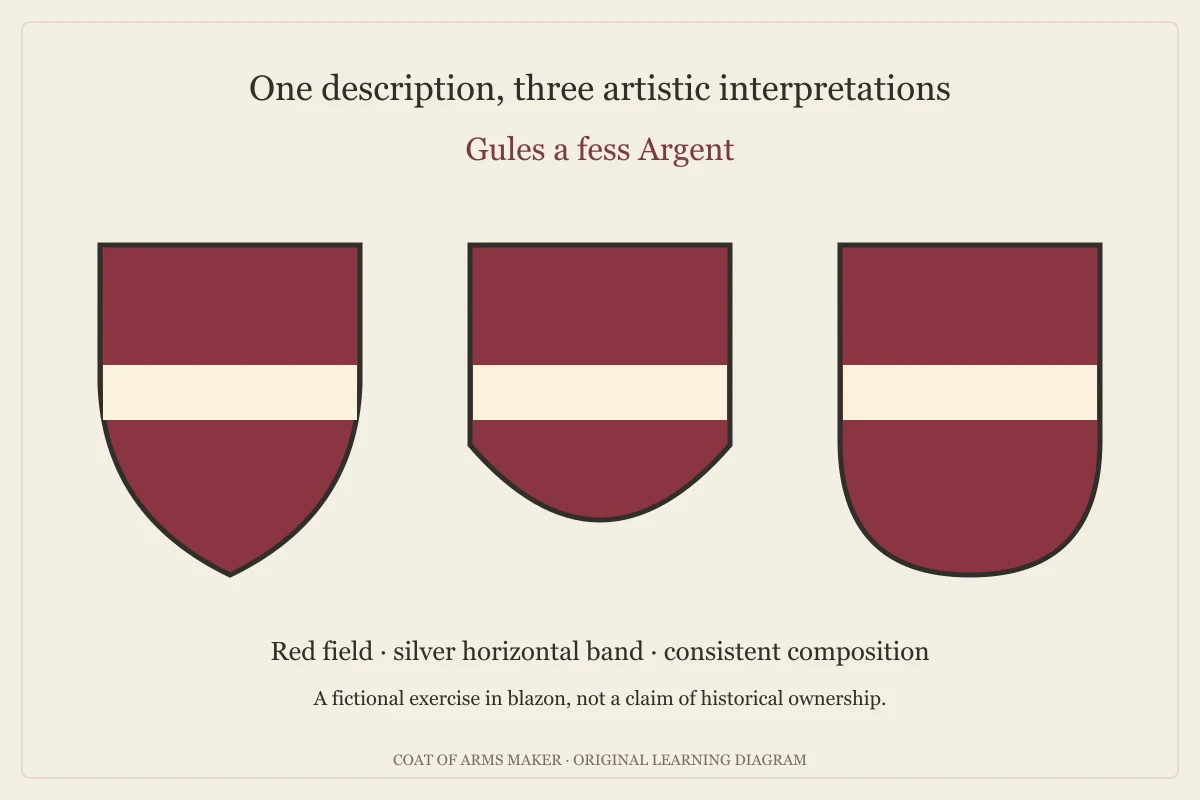
Consider the fictional description “Gules a fess Argent.” In plain English, it describes a red field with a silver or white horizontal band. This compact exercise uses established terms to specify the central arrangement. It does not identify a historical bearer or claim that the design is unique.
The three drawings above interpret that same description through different shield outlines. The band stays horizontal, the field stays red, and the band stays silver. Curvature and drawing style change. Heraldry can preserve identity across such artistic variation because the description supplies a common reference.
Now change the horizontal band into a vertical one. That changes the composition rather than simply changing the style. Add three stars and you have introduced further identifying features that the original description did not include. This is why a loose visual resemblance is not enough when comparing records.
Try this heraldry exercise in reverse: draw a simple shield, write a plain description, and ask someone else to draw it without seeing yours. Compare the results. Any surprising difference reveals an ambiguity in your instructions. Heraldry offers a disciplined way to think about that gap between an idea, its description, and its rendering.
What are the basic principles of heraldry?
Clarity is a useful starting point. A limited set of strong shapes is easier to recognize than a crowded scene. Traditional compositions often use bold contrast and distinctive arrangements. These observations are helpful to designers even when they are making a fictional emblem rather than reproducing historical arms.
One familiar convention concerns contrast between colors and metals. Gold and silver, often rendered yellow and white, form the metal group; several other named tinctures form the color group. The commonly taught rule discourages placing color directly on color or metal directly on metal. Historical practice includes complexities and exceptions, so treat a beginner’s rule as an introduction rather than a complete judgment tool.
Heraldry also depends on identity and differentiation. Count, placement, orientation, and composition can matter. If you reproduce a recorded design, do not alter those features merely because another arrangement looks prettier. For an original educational design, document your own decisions so later revisions remain consistent.
Finally, separate description from symbolic interpretation. A blazon tells an artist what to depict. It does not necessarily explain why the bearer chose each element. Heraldry is not a universal personality code in which every red field means one virtue and every animal has one fixed message.
Why traditions of heraldry differ
Heraldry is not governed by one worldwide office or one identical inheritance system. Different places developed different institutions, customs, and records. A claim about who may bear a particular design needs a named jurisdiction and appropriate evidence, not a rule copied without context from a general article.
Canada, for example, has a Canadian Heraldic Authority and a public register. The American Heraldry Society describes a different setting for personal arms in the United States, where there is no equivalent government heraldic authority for individuals. These examples illustrate variation; they are not a complete guide to recognition or legal use.
When studying an old design, ask where and when it was recorded. When considering a formal application or present use, consult the relevant authority’s current guidance. Historical description and current entitlement are related questions, but one should not be substituted for the other.
This regional variation is also why heraldry research begins with a specific person or institution. A surname alone may lead to unrelated bearers in several places. The design’s context determines which records and conventions are relevant.
Study heraldry with an evidence-first worksheet
Choose one clear image from a museum, archive, or official register. Note the institution, object title, date if supplied, and catalog identifier. In heraldry, a source you can revisit is more useful than an attractive image saved without context.
Next, make two columns: observation and interpretation. “Three small birds above a band” is an observation. “The birds represent three children” is an interpretation that needs support. Keep a third space for unanswered questions, including details obscured by damage or poor photography.
Look for the written description and compare it with the image. If they appear to disagree, check whether you are looking at the same object, a restoration, or a later rendering. Do not immediately assume either source is wrong. Heraldry research benefits from patiently identifying what each source actually claims.
End with a short account in your own words: what you identified, which source supports the attribution, and what you could not establish. This is enough for a useful beginner’s exercise. A confident story with no citations is less valuable than a careful account with one clearly stated uncertainty.
Is heraldry still used today?
Yes. Heraldry remains visible in civic, institutional, ceremonial, and personal contexts, although practices vary. You can encounter it on public buildings, university material, memorials, and official records. Its older visual language continues to support new designs as well as the interpretation of historic ones.
Modern reproduction introduces practical questions. A complex achievement that works on a large document may need a simpler presentation on a small screen. The solution is not to casually redesign recorded arms. Identify which elements must be preserved and seek an appropriate rendering for the intended size.
For fictional worlds and classroom projects, heraldry offers a rich design vocabulary. You can learn from contrast, composition, and description while clearly labeling an exercise as new or invented. An AI image tool can explore appearance, but it cannot establish ancestry, confirm a grant, or replace the source behind a historical attribution.
A practical route into heraldry
Begin with one simple shield and learn the names needed to describe it. Then compare two renderings of the same design. Next, examine a reliable record and identify the bearer. This sequence connects image, language, and evidence without requiring you to learn every specialized term at once.
For your own exercise, choose a single charge and two contrasting tinctures. Write what must stay consistent, then draw a rectangular banner and a shield version. Explain the meaning separately from the description. That separation is one of the most useful habits heraldry can teach a designer.
Keep a short reading list and revisit it when a specific question arises. Do not collect elaborate rules before you know which tradition you are studying. Curiosity, careful observation, and accurate source notes provide a stronger foundation than memorizing unsupported lists of symbolic meanings.
Questions & answers
What is the difference between heraldry and a coat of arms?
Heraldry is the wider practice and study of armorial identities. A coat of arms is a particular design within that system. The distinction is similar to the difference between a field of study and one of the objects it examines.
Is heraldry the same as genealogy?
No. Genealogy investigates relationships and descent. Heraldry studies armorial identities and their use. The subjects overlap when research connects a named bearer to a documented family line, but an image of a shield cannot replace genealogical evidence.
Do I need to know French to learn heraldry?
No. English-language blazon contains specialized vocabulary with historical French influence, but you can learn the terms gradually. Start with plain descriptions and a reliable illustrated glossary. Knowing the language does not remove the need to check the specific convention.
Can I use heraldry for a fantasy setting?
Yes. Borrow its attention to clear shapes, consistent descriptions, and recognizable differences between groups. State which rules your fictional setting follows, label its emblems as invented, and avoid presenting them as historical grants or evidence of real ancestry.
Continue learning
- Identify the parts of a coat of arms
- Learn colors, metals, and contrast
- Explore six fictional faction designs
- Start a documented heraldic research project
Practice with an original design — Explore a simple shield composition, then review it against your written brief.
Sources & further reading
- The Heraldry Society: introduction to heraldry
- American Heraldry Society: what is heraldry?
- Cambridge University Heraldic and Genealogical Society: description and interpretation
- Governor General of Canada: contemporary heraldry
- Medievalists.net: historical development and origins
The examples and illustrations in this guide are original educational designs. They do not document grants of arms or establish anyone’s ancestry.