A fantasy coat of arms gives a fictional house, city, guild, or order an identity readers can recognize before they read its name. Start with what the faction does, choose one clear symbol, then make the design work on a banner and a small token. The six examples below are original worldbuilding exercises. Each includes a story, a visual decision, a prompt, and a limitation to test. They borrow the clarity of heraldic design without claiming to be historical grants of arms.
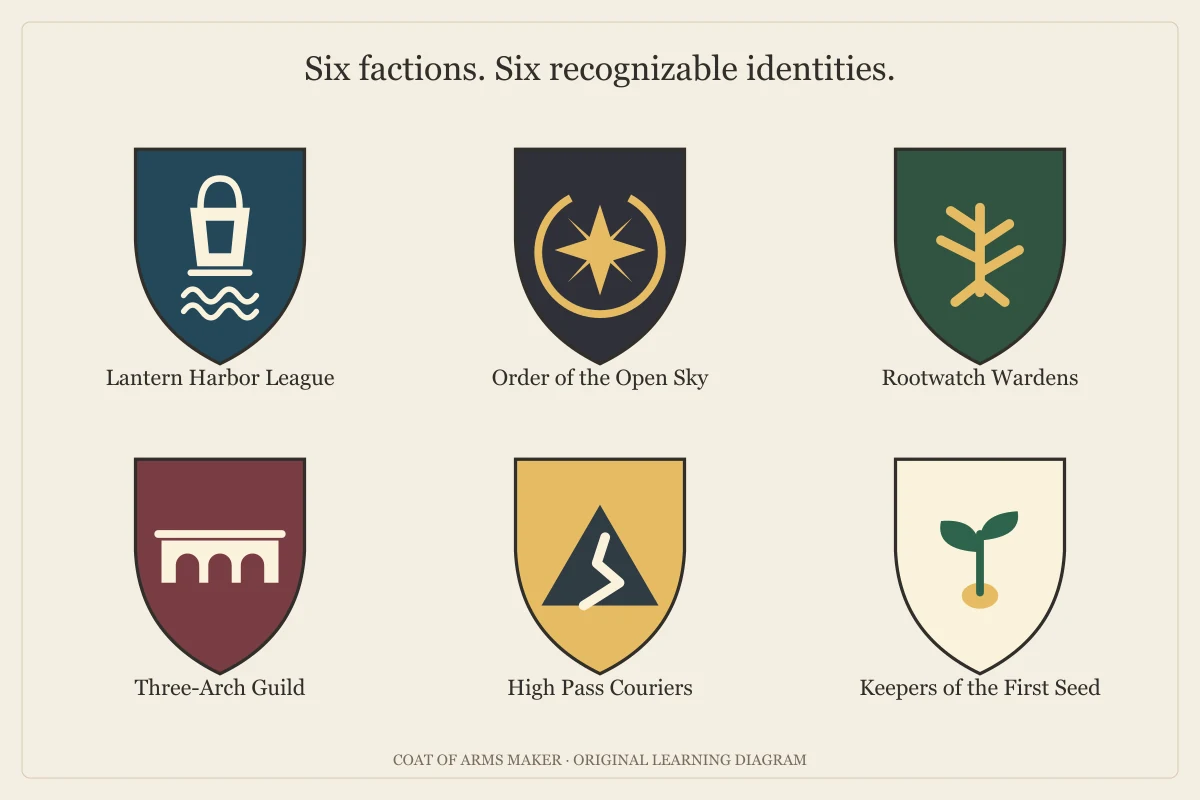
Plan your fantasy coat of arms around a faction’s role
A fantasy coat of arms becomes easier to design when the faction has a specific role. “A powerful kingdom” gives you little to draw. “A harbor league that keeps winter shipping routes open” suggests lights, water, protection, and shared responsibility. Choose the detail that makes this organization different from the neighboring one.
Write down its public promise and private tension. A bridge guild may promise safe passage while charging unfair tolls. A forest order may protect old trees but disagree about expanding towns. A fantasy coat of arms usually communicates the public identity; the story can reveal how well the faction lives up to it.
Decide where the fantasy coat of arms appears. Soldiers need a readable banner, while archivists might use a seal. A fantasy coat of arms intended for both should begin as a strong silhouette. Weathering, metal textures, and elaborate frames can come later, after the underlying design works without them.
1. The Lantern Harbor League
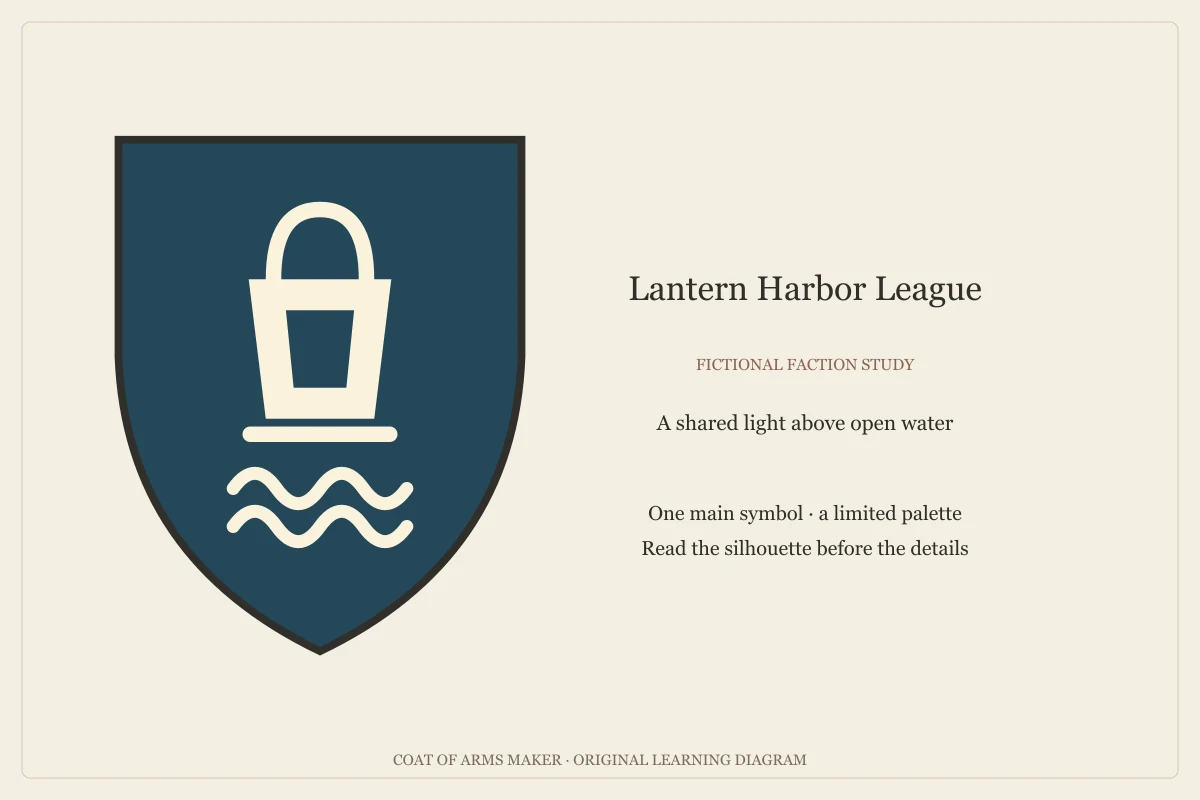
Story: several coastal towns maintain a chain of lamps so ships can travel between them in winter. Their fantasy coat of arms uses a lantern above two waves on a deep blue field. The lantern expresses the work they share; the water identifies the setting. These meanings belong to this fictional league rather than a universal heraldic dictionary.
Prompt: “An original fantasy coat of arms for a cooperative harbor league: one large ivory lantern, two broad ivory waves below, deep blue shield, flat heraldic illustration, clean edges, no text, no crown, no surrounding scenery.” Keeping the scene outside the fantasy coat of arms prevents the design from turning into a landscape painting.
Test: shrink the image until the lantern is roughly the size of a fingernail. If its window becomes an indistinct grid, simplify it to one opening. The fantasy coat of arms should still read as a lamp above water when copied onto a painted crate. A lighthouse would also work, but avoid using both unless the story needs the distinction.
2. The Order of the Open Sky
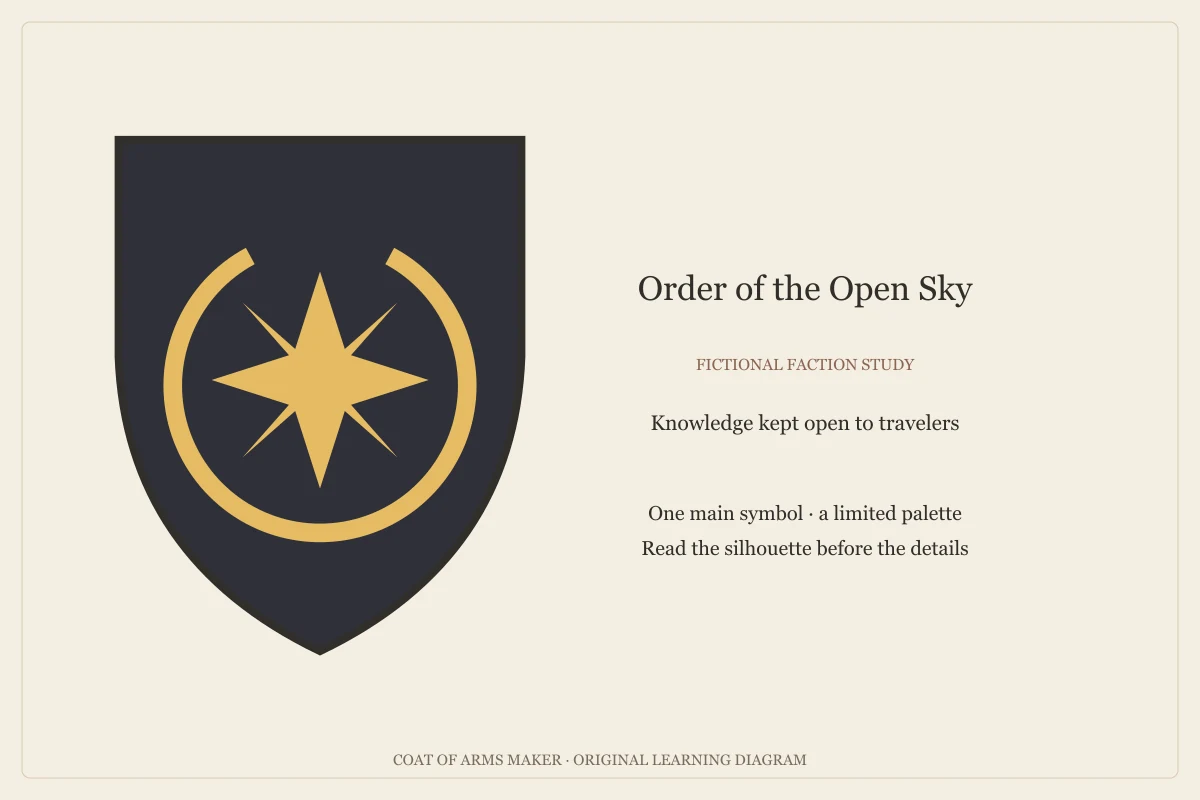
Story: an observatory shares weather observations with travelers, though its patrons want to keep predictions private. Its fantasy coat of arms uses a gold star inside an open ring on a dark field. The opening in this fantasy coat of arms is a deliberate fictional reference to public access, not an assertion about historical symbolism.
Prompt: “A fantasy coat of arms for an order of astronomers: one gold eight-point star centered inside a broad open gold ring, near-black field, balanced negative space, simple shield, flat colors, no lettering, no planets, no gradients.” Keep the gap in the ring wide enough to survive reduction.
Test: compare this design with any religious or organizational symbols familiar to your audience. A star and ring are common geometry, so arrangement matters. If the fantasy coat of arms looks too close to a real emblem, change the structure rather than adding tiny decorative differences. Write down the gap position so future artists reproduce it consistently.
3. The Rootwatch Wardens
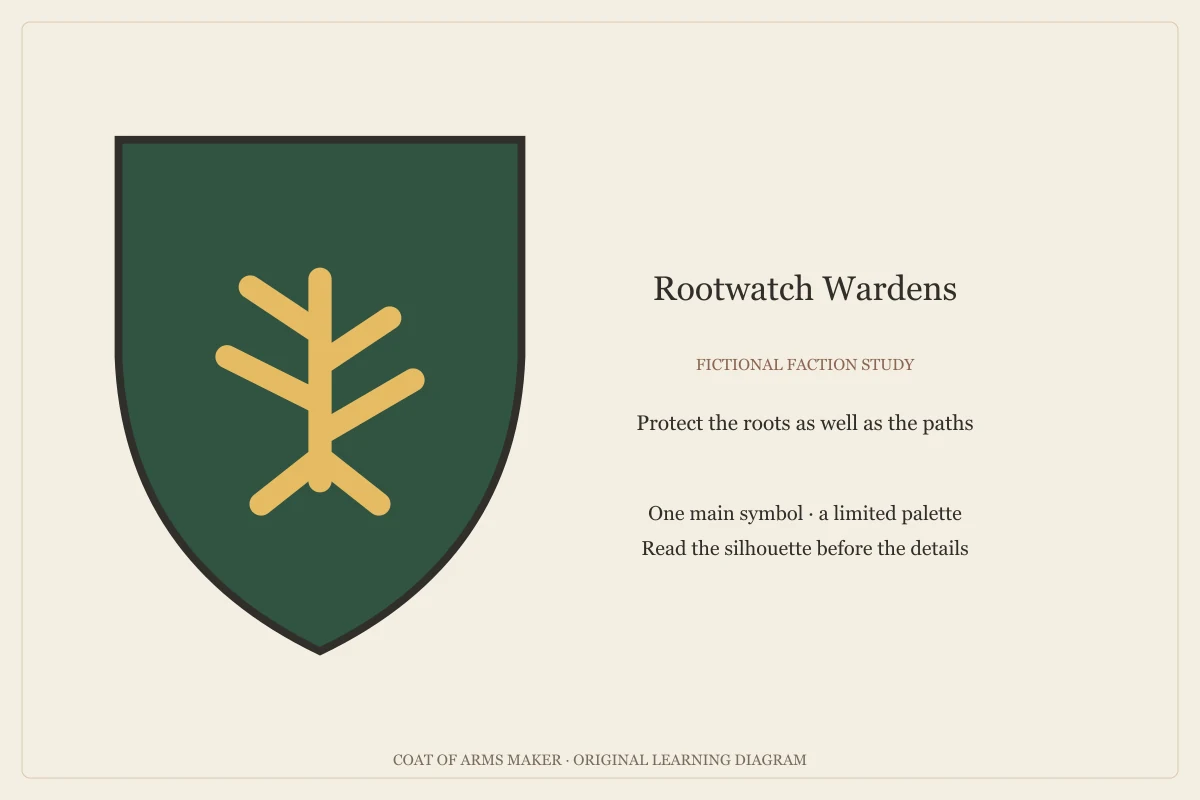
Story: woodland villages appoint wardens to maintain paths and protect common ground. Their fantasy coat of arms uses a single gold tree with visible roots on green. The roots are the important feature: the order protects the living system below the surface as well as the visible forest.
Prompt: “An original fantasy coat of arms for woodland path wardens: one gold tree with three broad branches and visible roots on a deep green shield; geometric, sturdy, symmetrical silhouette; no faces, no lettering, no landscape background.” Use a short branch count as a compositional instruction, not a requirement that the generator will always obey.
Test: check whether the roots resemble flames or antlers at small sizes. A fantasy coat of arms needs a distinctive outline more than realistic bark. For rival branches of the order, change a substantial feature such as the surrounding border, while preserving the central tree so the shared origin remains visible.
4. The Three-Arch Guild
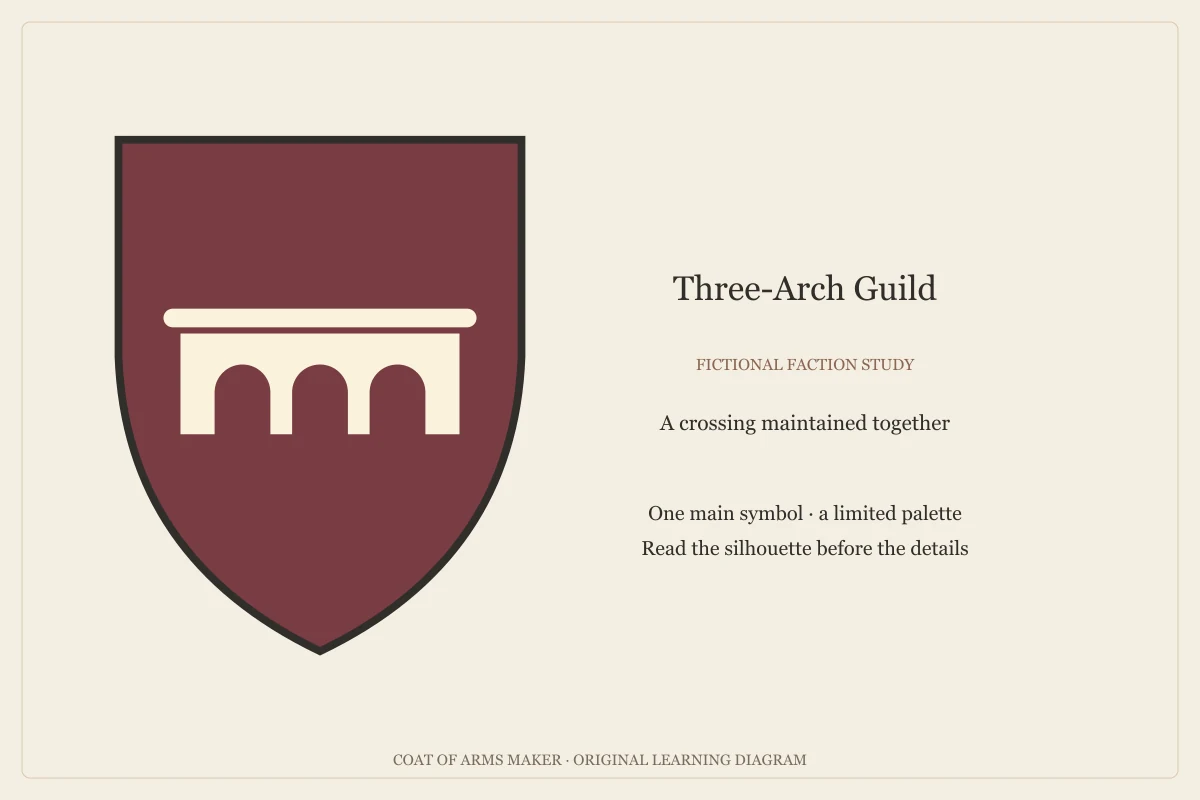
Story: engineers maintain the only permanent crossing over a floodplain. Their fantasy coat of arms uses a pale bridge on a red field. The three openings recall the original crossing. In the story, travelers argue whether the guild’s rising fees pay for repairs or enrich its council.
Prompt: “A fantasy coat of arms for a bridge-building guild: one ivory bridge with three large open arches on a dark red shield; straight parapet, broad supports, flat graphic treatment, no river scene, no motto, no crown.” In this fantasy coat of arms, the negative space inside the arches should be as deliberate as the bridge itself.
Test: print a small version in one color. If the arches fill in, the symbol becomes a wall. Redraw the openings before adding masonry. This fantasy coat of arms can appear on toll markers and repair tools, making the same graphic a practical object in the world rather than a decoration that exists only in an appendix.
5. The High Pass Couriers
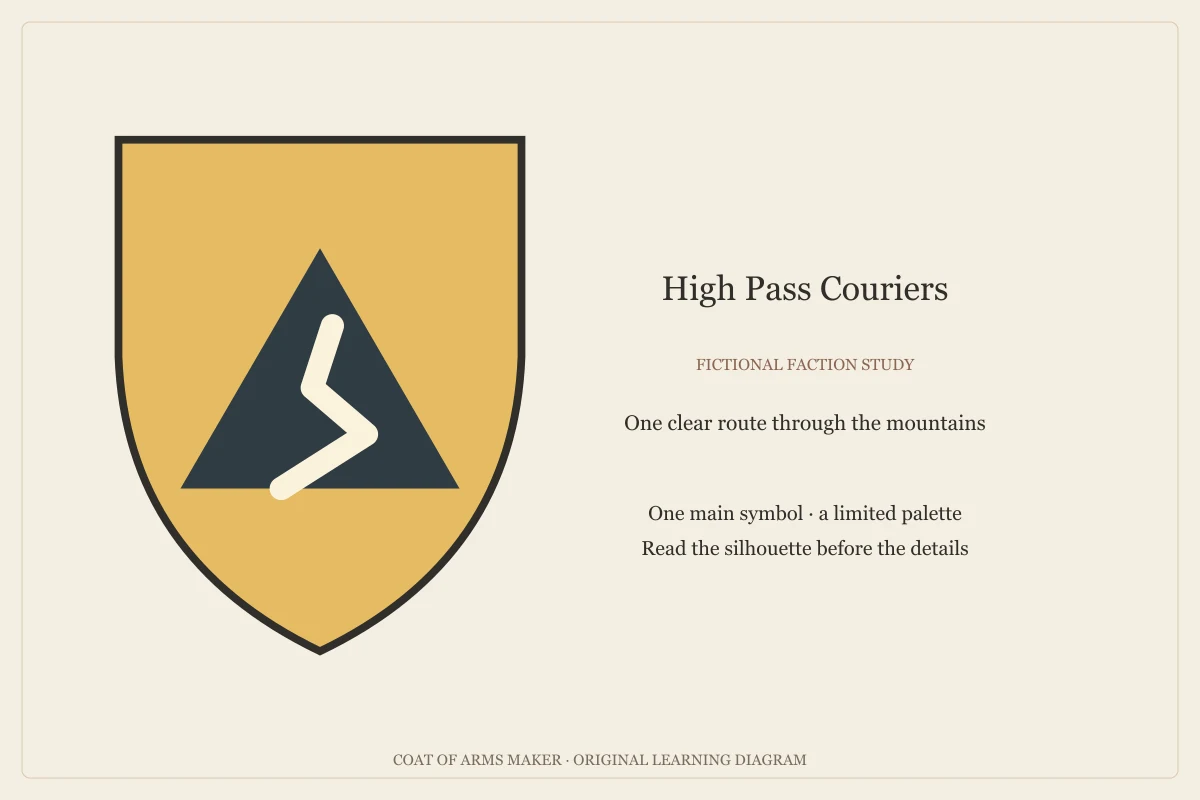
Story: couriers cross a mountain route that armies cannot use in winter. Their fantasy coat of arms shows a dark peak crossed by a pale ascending path on gold. Within this fantasy coat of arms, the path, rather than a sword or an eagle, makes their work identifiable. It also gives the faction a useful visual contrast with military houses.
Prompt: “A fantasy coat of arms for mountain messengers: a single dark mountain with one broad pale path climbing through it, gold field, minimal shield, flat shapes, no tiny figures, no lettering, no snow texture.” Keep the route continuous and check the generated artwork for disconnected sections.
Test: ask someone whether they see a mountain, an arrow, or a tent. Adjust the profile if the wrong reading dominates. A fantasy coat of arms does not need to describe the entire mountain range. One strong peak is enough to imply the landscape and leave room for the path.
6. The Keepers of the First Seed
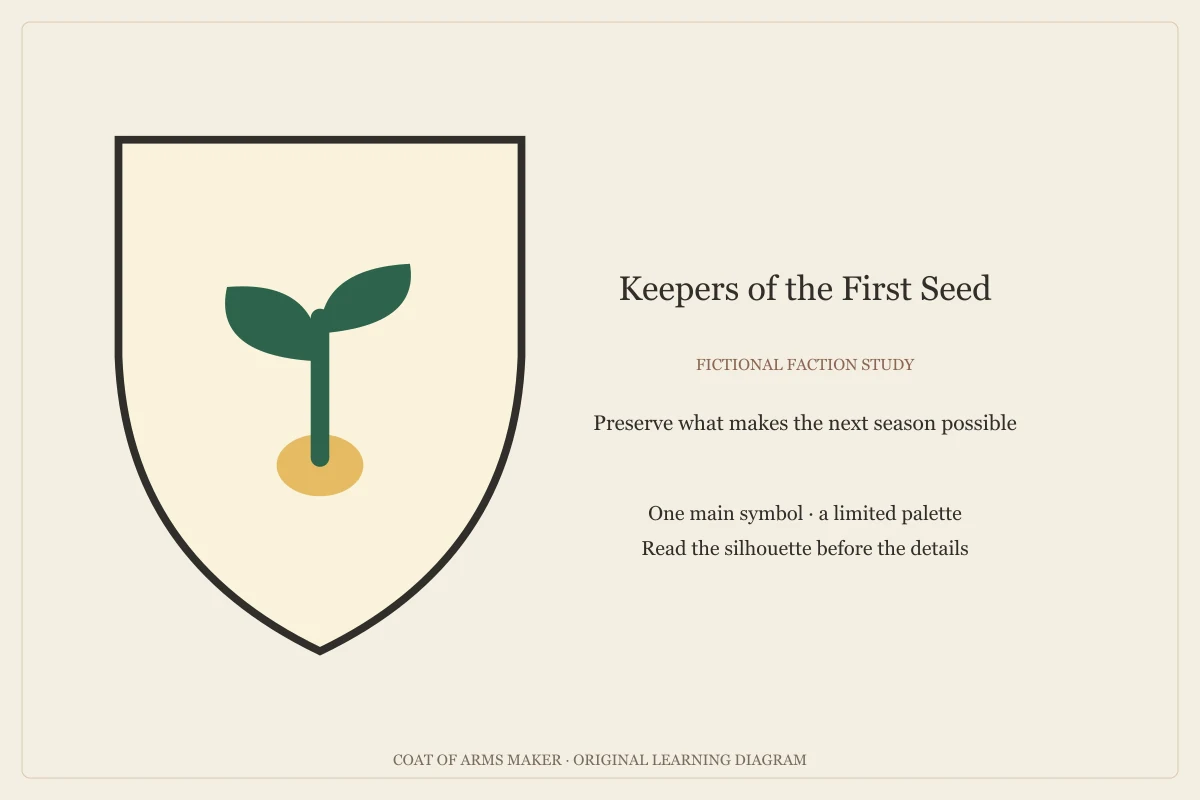
Story: a network of farming settlements stores seed after a series of failed harvests. Its fantasy coat of arms uses a green seedling rising from a gold seed on ivory. The new growth is public hope; the carefully guarded storehouse can become a source of political conflict.
Prompt: “An original fantasy coat of arms for a seed-saving fellowship: one green two-leaf seedling emerging from a gold seed, ivory field, simple rounded shield, broad flat forms, no tools, no landscape, no words.” Let the stem visibly connect the seed and leaves rather than floating above them.
Test: inspect the gold against ivory. If the seed disappears, enlarge its darker outline or choose a darker seed color for this fictional design. This fantasy coat of arms is a useful reminder that an attractive palette still needs practical contrast. Decorative freedom does not remove the need to see the symbol.
Keep a fantasy coat of arms consistent across factions
Build a small style sheet for each fantasy coat of arms. Record the main symbol, colors, orientation, number of repeated objects, and features that must remain unchanged. Separate those identity decisions from artistic choices such as brush texture or shield outline. This lets different illustrators work on the same world without accidentally inventing new factions.
For an alliance, choose one shared element: perhaps a small top band or a common border. For a breakaway group, change a conspicuous feature and explain it through the story. A fantasy coat of arms should communicate difference at a glance. Two factions distinguished only by a tiny leaf are difficult to follow on a map.
Decide whether your world uses inherited arms, appointed offices, or collective guild marks. Do not quietly switch the system between chapters. Your fantasy coat of arms can follow invented rules, but readers benefit when those rules have consequences. A disputed emblem can reveal a succession conflict more effectively than another paragraph of family history.
Adapt a fantasy coat of arms for game assets
Create a plain master first, then adapt it to its destination. A fantasy coat of arms on a banner may need a rectangular composition; a token needs wider gaps and fewer details. Do not simply crop away important charges to fit a different shape. Recompose while preserving the identifying relationships.
Use the prompts as briefs for exploration, then inspect every result. Check object count, symmetry where intended, disconnected shapes, accidental letters, and resemblance to established fictional franchises. A generated fantasy coat of arms is not automatically a clean vector, a registered mark, or a historically valid grant. Save the chosen design and a written description together.
Finally, view all six emblems at the same size and in grayscale. Can a player distinguish them without the faction names? If not, change the largest shapes before changing surface texture. A useful fantasy coat of arms remains recognizable after the gold foil, dramatic lighting, and painted parchment are removed.
Questions & answers
Can I create my own fantasy coat of arms?
Yes, you can develop an original emblem for a fictional world. Establish your setting’s rules and label the result as fictional. Creating artwork does not make it an official historical grant, and borrowing another creator’s recognizable faction emblem is different from designing your own.
What is the difference between a fantasy crest and a coat of arms?
People often use crest for a complete fictional emblem. In traditional heraldic terminology, the crest is an element above the helmet, while the arms are centered on the shield. Decide which object your brief actually needs before adding ornaments.
Should every faction use a dragon or a lion?
No. Objects tied to the faction’s work often make a more distinctive fantasy coat of arms. A bridge, lamp, seedling, or instrument can communicate an identity that a generic powerful animal cannot. Use an animal when its role in the story earns the choice.
Can I use these prompts for a tabletop campaign?
Yes. These original educational prompts are starting points for your own campaign designs. Adapt the names, stories, and symbols to your setting, and review the terms of the image tool you use before distributing or selling its output.
Continue learning
- Build a shield from a focused design brief
- Choose readable heraldic colors
- Create a compact fictional sigil
Create a fictional shield — Start with one faction brief, then review the generated composition.
Sources & further reading
- English Heritage: heraldic shapes and charges
- DrawShield: examples of blazon-based design tools
- Armoria: a component-based fantasy heraldry editor
The examples and illustrations in this guide are original educational designs. They do not document grants of arms or establish anyone’s ancestry.