A coat of arms is a distinctive heraldic design centered on a shield. It identifies a bearer, such as a person or institution, through a particular arrangement of colors and symbols. The surrounding helmet, crest, motto, and other ornaments may form a fuller display called an achievement. The shield remains the starting point for understanding the design. Below, you will learn to recognize the main parts, read one fictional example, and distinguish an actual historical record from a modern decorative emblem.
A coat of arms expresses an identity on a shield
Think of a coat of arms as an organized visual identity rather than a collection of attractive medieval objects. The design matters as a whole: the background, the figures placed on it, their colors, and their arrangement. Two shields can contain the same animal yet represent different bearers because the remaining details differ.
The expression is also used more loosely for the complete decorated display. When accuracy matters, specify whether you mean the shield alone or the full achievement. A coat of arms does not require every ornament that appears in an elaborate illustration. A simple shield can communicate the essential arms without a helmet, ribbon, or pair of supporting animals.
Heraldry is the broader field that describes, studies, designs, and records these identities. A coat of arms is one object within that field. This distinction helps you choose the right question: identifying the object is different from studying the system that governs its description and use.
What is on a coat of arms?
Start with the shield of the coat of arms. Its background is called the field. Figures placed on the field are charges, which may include animals, plants, tools, or geometric forms. Broad conventional shapes such as a horizontal band or chevron are often called ordinaries. You can recognize these components before learning any specialized vocabulary.
Outside the shield of a coat of arms, a helmet may sit above it, with mantling arranged around the sides. A crest appears above the helmet, often on a wreath of twisted cloth. A motto is a short phrase, commonly shown on a scroll. Supporters stand to either side in some achievements. These elements have different conventions across traditions, so their presence is not a universal checklist.
On a coat of arms, the crest is therefore a specific part rather than a technical name for the entire picture. Everyday language often calls the whole image a family crest. Knowing both usages lets you understand an informal request while describing a historical example more precisely.
Do not infer rank, entitlement, or personal history from an unfamiliar ornament alone. In a decorative illustration, a crown may simply have been added for visual effect. In a documented achievement, similar-looking ornaments may have a specific significance. The source and context determine which interpretation is justified.
Read a coat of arms from the center outward
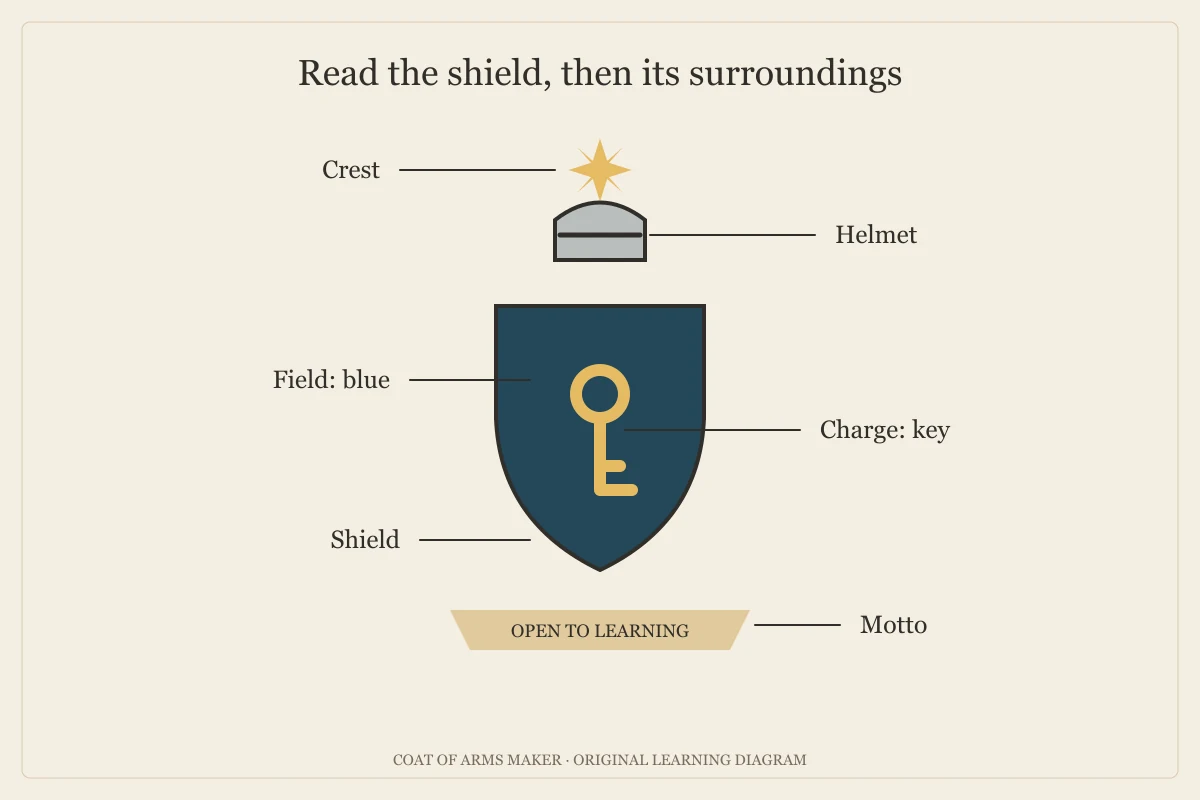
Our fictional teaching example uses a blue shield with a gold key, a helmet, a small star crest, and the motto “Open to learning.” It is an original educational design, not the coat of arms of a historical family. Its purpose is to let you locate the parts without needing to decode a complicated inherited composition.
To read this coat of arms, first describe what you can actually see: a blue field and one gold key. Then look above the shield for the helmet and the separate star. Finally read the motto. This sequence keeps the main design distinct from its surrounding decoration. If someone removes the ribbon from the illustration, the shield still carries the same central identity.
For this exercise, we assign the key a meaning related to access to knowledge. That interpretation comes from our design brief. You should not conclude that every key on every coat of arms means education. A historical bearer may have selected the same object for a name, office, event, local association, or another reason.
Now imagine redrawing the key on this coat of arms with a rounder bow and a shorter stem. If its essential identity, color, and placement remain consistent, the new illustration may still represent the same described design. If you replace the key with a tower, you have changed a defining element rather than merely changing the drawing style.
What does a coat of arms represent?
A coat of arms identifies its bearer. Depending on the context, that bearer might be an individual, a civic body, a school, or another organization. The imagery can also express associations, achievements, places, or values, but you need evidence to explain those associations confidently.
Consider an institutional coat of arms that includes a bridge. It could refer to a local landmark, the institution’s founding location, or a symbolic connection. The picture alone does not tell you which explanation is correct. Look for an official description, grant, register entry, or reliable account of the design’s origin.
A coat of arms is not automatically a statement that the bearer is royal or noble. Nor does a similar surname establish that two people share the same arms. Those assumptions often arise when decorative merchandise is presented without a named bearer or source.
For a new coat of arms project, write the intended meaning beside your sketch. A clear explanation such as “the bridge recalls the town where we met” is more useful than a list of supposedly universal virtues. Keep that account with the artwork so future viewers can distinguish your intention from later speculation.
Why is a coat of arms centered on a shield?
The recognizable European system of hereditary arms developed in the Middle Ages, particularly during the twelfth century. Shields and other visible displays helped distinguish identities in settings associated with armored elites. Over time, heraldic designs appeared in many additional settings, including seals, buildings, manuscripts, and civic imagery.
A coat of arms is therefore not simply any picture painted on an ancient shield. The later heraldic system involved repeatable identities and conventions of description and transmission. Earlier symbols can look superficially similar without belonging to the same developed tradition.
Today you may encounter a coat of arms on an official building, university publication, memorial, or historical object. The coat of arms can connect the object with a particular institution or person, but it is not enough by itself to date the object. A modern reproduction can display a much older design.
When researching a historical coat of arms, record where it appears and whether the image is contemporary with the object. A replacement window, later engraving, or restored painting may preserve an old identity through a newer artistic interpretation. Separate the age of the design from the age of the particular artwork.
How a blazon describes a coat of arms
A formal heraldic description is called a blazon. It specifies the design through established vocabulary and ordering conventions. This allows artists to interpret a coat of arms without treating a single image file as the only correct rendering. The description and the artwork perform related but different jobs.
When describing a coat of arms, plain language is a useful first step: identify the field, principal charge, colors, count, and placement. Then compare that description with a trusted reference. Do not invent technical terms to make a new design sound official, and do not assume that an AI-generated sentence is an accurate blazon.
A coat of arms can be drawn in different shield outlines and artistic styles while preserving its identifying composition. A change in brushwork is different from a change in charge count. Learning that distinction helps when comparing a carved example with a painted one.
Colors also have specialized names. Azure refers to blue, gules to red, and argent to silver or white. Learning the names helps you read a description; it does not turn each color into a fixed personality trait. For a detailed palette reference, continue to our guide to heraldic colors and tinctures.
Coat of arms, crest, badge, logo, and seal
A crest is a component above the helmet in a full heraldic display. A badge is another identifying device that can exist separately from the shield. A seal is a means of authenticating or marking something and may display arms, writing, or another design. These terms describe different functions and objects.
A logo can also identify a person or institution, but it does not necessarily follow heraldic conventions. A shield-shaped logo is not automatically a historical coat of arms. Likewise, an attractive emblem with a ribbon and animal supporters may be a contemporary illustration rather than a recorded achievement.
When commissioning artwork, name the deliverable plainly. “A shield-only emblem for a school activity” is a different request from “a historically researched reproduction of this recorded coat of arms.” The second requires a source and careful attention to its description; the first can focus on an original educational design.
Keep the distinction visible when sharing the result. Label a fictional example as fictional, a modern family design as new, and a reconstruction with the source it follows. Clear labels let viewers appreciate the artwork without drawing unsupported conclusions about ancestry or status.
Practice reading a coat of arms in five minutes
Choose a clearly photographed coat of arms from a museum or official institution. Cover the caption and describe only visible features. Begin with the shield, then name the largest charge and its position. List surrounding ornaments separately. If a detail is too small to see, mark it as uncertain rather than guessing.
Uncover the coat of arms caption and compare. Did you confuse the crest with a charge? Did you overlook a repeated object? Did you assign a meaning that the source never mentioned? The exercise builds a useful habit: observation first, interpretation second, historical attribution only when evidence supports it.
For a creative follow-up, sketch an original shield using one large object and two contrasting colors. Explain its meaning in a sentence. You can explore a coat of arms inspired design without claiming that the sketch documents inherited arms. Save more complex compositions for after the basic silhouette reads clearly.
Questions & answers
What is a coat of arms in simple terms?
It is a distinctive heraldic design centered on a shield that identifies a particular bearer. A complete display may add a helmet, crest, motto, and other ornaments. Those surrounding elements should not be confused with the shield itself.
Does everyone with the same surname share a coat of arms?
No. A surname match alone does not establish a relationship to a documented bearer or a right to use the arms. Research a particular person, place, and family line, then consult the conventions relevant to that record.
Can a coat of arms exist without a motto?
Yes. A motto is not required for every display. The central shield can carry the identifying design without a ribbon or phrase. Do not add a motto to a historical reproduction unless the source supports it.
Can I make my own coat of arms for a project?
You can design an original decorative or fictional shield for a project. Describe it as a new design, avoid copying an existing bearer’s arms, and distinguish artwork creation from any formal grant or recognition process.
Continue learning
- Explore the wider system of heraldry
- Compare a shield, crest, and full achievement
- Choose a printable shield worksheet
- Learn heraldic color names
Explore an original shield design — Turn a simple object and palette into a new decorative composition.
Sources & further reading
- Governor General of Canada: parts of a coat of arms
- The Heraldry Society: the coat of arms
- Historic UK: coats of arms, by Peter O’Donoghue
- Cambridge University Heraldic and Genealogical Society: heraldry and blazon
The examples and illustrations in this guide are original educational designs. They do not document grants of arms or establish anyone’s ancestry.