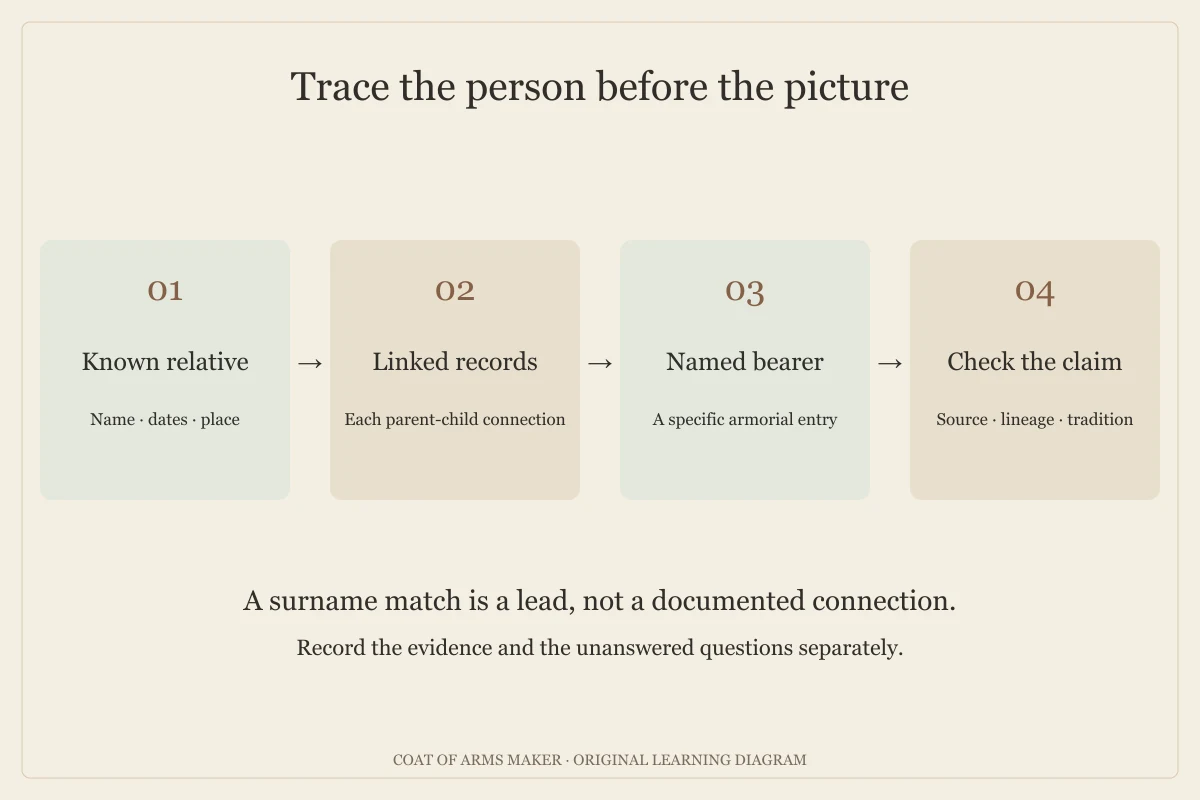
To find a historical family crest, start with a documented ancestor rather than an image search. Identify where that person lived, follow the relevant family line, and look for a heraldic record naming a specific bearer. A matching surname is a lead, not proof that the design belongs to your branch. This guide gives you a practical research sequence, a way to record uncertainty, and an example of how to evaluate a promising match without turning it into an unsupported family story.
Decide what you mean by “family crest”
In everyday searches, family crest often means a complete shield with surrounding ornaments. In heraldic terminology, the crest is the element above the helmet. You may therefore find a record that describes a shield and a separate crest. Save both descriptions instead of assuming that every picture associated with the surname represents the same object.
Also separate three questions: Did someone with this name bear arms? Am I related to that person? Does the relevant heraldic tradition recognize a right to use those arms through this line? A family crest search can answer the first question without answering the other two. Keep the conclusions separate in your notes.
If your goal is a new reunion emblem, you do not need to discover a historical family crest first. You can create an original decorative design and label it honestly. If your goal is historical identification, however, a new image or AI-generated reconstruction cannot supply missing genealogical evidence.
1. Begin your family crest search with a known person
Choose one ancestor whose identity you can support with records. Write down the full name, approximate dates, places, spouse, occupation, and known children. A family crest query becomes much more useful when “Morgan” becomes a particular Morgan living in a particular town during a particular period.
Work backward through parent-child connections instead of jumping from a modern surname to a medieval name. Birth, marriage, death, census, probate, and parish records may help, depending on the location and period. Read the actual record when available. An index or an unsourced online tree can point you toward evidence but may contain transcription or identification errors.
In your family crest research notes, keep each generation on its own row. Record what supports the relationship and what remains uncertain. If two people have the same name, compare dates, addresses, occupations, and relatives. A family crest attached to the more famous person is not a reason to choose that person as your ancestor.
Do not publish sensitive information about living relatives in a public research log. You can keep working notes privately and share a reduced account of the historical evidence later. The purpose of a family crest project is not to expose every document gathered along the way.
2. Locate the family crest in a place and period
Follow the geography in your evidence. A surname may appear in several unrelated regions, and a family may have moved between countries. Search the jurisdiction relevant to the particular bearer, rather than assuming that the country where you live now controls every earlier record.
Heraldic practices and inheritance conventions vary. A family crest reference from one tradition should not be interpreted through a rule copied from another. Use the responsible authority or a specialist historical source for the place involved. If the question becomes one of present entitlement, seek a determination from the appropriate authority rather than treating this design guide as a ruling.
Make a short search brief: “Looking for an armorial record for [person], associated with [place], around [dates], possibly described in [source].” That is more useful to an archive than “Please find my family crest.” Include the evidence you already have and distinguish known dates from estimates.
3. Search for a family crest linked to a named bearer
An armorial is a collection of arms; a grant or registration records a particular heraldic action. Published pedigrees, visitation records, seals, monuments, and institutional collections may provide further clues. Their coverage and reliability differ. Record the source’s date, compiler, and scope before assuming it includes every possible family crest.
To investigate a family crest, use library catalogs and archive finding aids to locate the relevant publication or collection. Search spelling variants supported by your documents, not an unlimited list of similar names. When a reference points to another book, follow that citation where possible. Repeated copies of one unsupported claim are still one unsupported claim.
A useful family crest record should let you identify the bearer, the source, and the design being described. Save the page number or entry identifier. If an image appears without a citation, search for the underlying description rather than treating the image as self-authenticating.
Official public registers can be particularly helpful within their stated scope. For example, the Canadian Heraldic Authority provides a public register of Canadian arms, flags, and badges. It is a place to examine recorded entries, not a worldwide surname database or proof that any matching family crest is yours.
4. Keep a family crest research log
Use a spreadsheet or notebook with consistent fields. Your family crest log should be understandable to someone who did not sit beside you during the search. Write enough detail to reopen the source and see why you considered it relevant.
Record negative searches too. “No result in this collection using these spellings on this date” is a useful finding. “No family crest exists” is a much broader claim that an incomplete database cannot support. A missing entry may reflect limited coverage, unindexed records, or an incorrect assumption about the person.
Give each lead a status such as unverified, source located, identity matched, or relationship unresolved. Avoid a single “confirmed” checkbox that conceals which part of the claim was checked. Family crest research often advances unevenly: you may verify an armorial entry while still lacking a generation in the family tree.
- Person: full name, dates, place, and distinguishing relatives.
- Source: archive or book, entry or page, stable link, and access date.
- Observation: what the record actually says, including the named bearer.
- Connection: the documents linking that bearer to the line under investigation.
- Uncertainty: conflicting dates, missing generations, unclear handwriting, or unknown provenance.
- Next action: one specific record or question to investigate.
Worked example: two people named Thomas Vale
Imagine you are researching a fictional ancestor, Thomas Vale, a carpenter recorded in a coastal town in 1840. A shop displays a family crest for “Vale,” while an old armorial names a Thomas Vale associated with an inland estate a century earlier. The repeated name is interesting, but place, date, and occupation do not establish a connection.
Your first log entry should say that an armorial lead exists, with the book and page if available. It should not say that you have found your family crest. Next, trace the carpenter’s parents and compare the estate bearer’s documented descendants. If those lines do not meet, the match remains unproven.
Suppose a probate record identifies a relative who could bridge the gap. Check whether its dates and relationships fit both lines. Do not silently insert the person because the connection is convenient. If the record contradicts your proposed tree, revise the tree and preserve the rejected hypothesis in your notes.
This example shows why an attractive family crest is a poor starting conclusion. The final result might be a documented connection, a different bearer, or no connection at all. Each outcome is more useful than an inherited story built on a surname match.
5. Treat a family crest image as a clue
A seal, signet ring, bookplate, or piece of silver may carry valuable evidence, especially if its ownership history is known. Photograph the whole object and close details, record its dimensions, and note where it came from. A family crest on an object might identify an earlier owner rather than the person who later inherited or purchased it.
Compare the composition, not just a single animal. Count the charges, note their positions, and distinguish the shield from the crest above it. Artistic style can vary between renderings of the same arms, while small structural differences can identify different designs. Keep the written description alongside the image when one exists.
Be cautious with surname merchandise that presents one family crest without naming a bearer or source. Ask for the underlying record. A decorative product can still be enjoyable, but its appearance, age effect, or printed certificate does not establish your ancestry.
Do not ask an image generator to fill in a missing historical family crest and then use the result as evidence. A reconstruction may help illustrate a clearly identified description, but label the reconstruction and retain the source. Generated detail can easily look plausible while being invented.
6. Write a family crest research conclusion
End the first research round with a short conclusion: what record was located, whom it names, which relationships are documented, and which questions remain open. If you found no supported family crest connection, say so. That does not diminish the family history you have established.
If you want an expert review, provide this concise evidence packet rather than a folder of unexplained screenshots. Ask a focused question about a person, record, or proposed relationship. Confirm the scope and fees of any paid service before commissioning it; this guide does not promise a free or complete official search.
For a new decorative emblem, use the stories you did verify: a place, trade, journey, or shared value. Keep the wording distinct from a claim to inherited arms. A modern family crest design can celebrate your family without being presented as a recovered historical object.
Questions & answers
How can I find out my family crest for free?
Start with records you already have, public library resources, and freely accessible catalogs or registers. Some original documents or specialist research may require payment. A free surname image is not equivalent to a documented connection to a named bearer.
Does every family have a crest?
No. Not every family line includes a documented bearer of arms, and heraldic traditions were not universal. Failure to find a family crest in one database also does not prove that no relevant record exists anywhere.
Can I find my family crest by last name alone?
A last name can help locate leads, but it cannot establish your connection to the bearer. Combine it with dates, places, relatives, and records. People sharing a surname may belong to unrelated lines.
What should I do if I find several different designs?
Record each design’s named bearer, place, date, and source. Several legitimate entries may involve different people or branches. Do not select the family crest you like best and assume it represents your ancestry.
Continue learning
- Understand the crest and shield distinction
- Understand heraldic records and terminology
- Create an original emblem from your own story
Create a new decorative emblem — For a new design based on your story; this tool does not search genealogical records.
Sources & further reading
- MyHeritage: researching a named bearer rather than a surname
- FamilySearch: family crests and coats of arms
- Governor General of Canada: heraldry and public register access
- American Heraldry Society: traditions and ancestral arms
The examples and illustrations in this guide are original educational designs. They do not document grants of arms or establish anyone’s ancestry.