Family symbols can represent belonging, care, continuity, or a particular memory. There is no single universal sign that means family to everyone. A tree may suggest generations; a table may recall Sunday meals; a bridge may express a connection across countries. The most useful choice is one the people involved recognize and can explain. This guide compares twelve possibilities, then shows how to choose family symbols without inventing a historical meaning or claiming an inherited coat of arms.
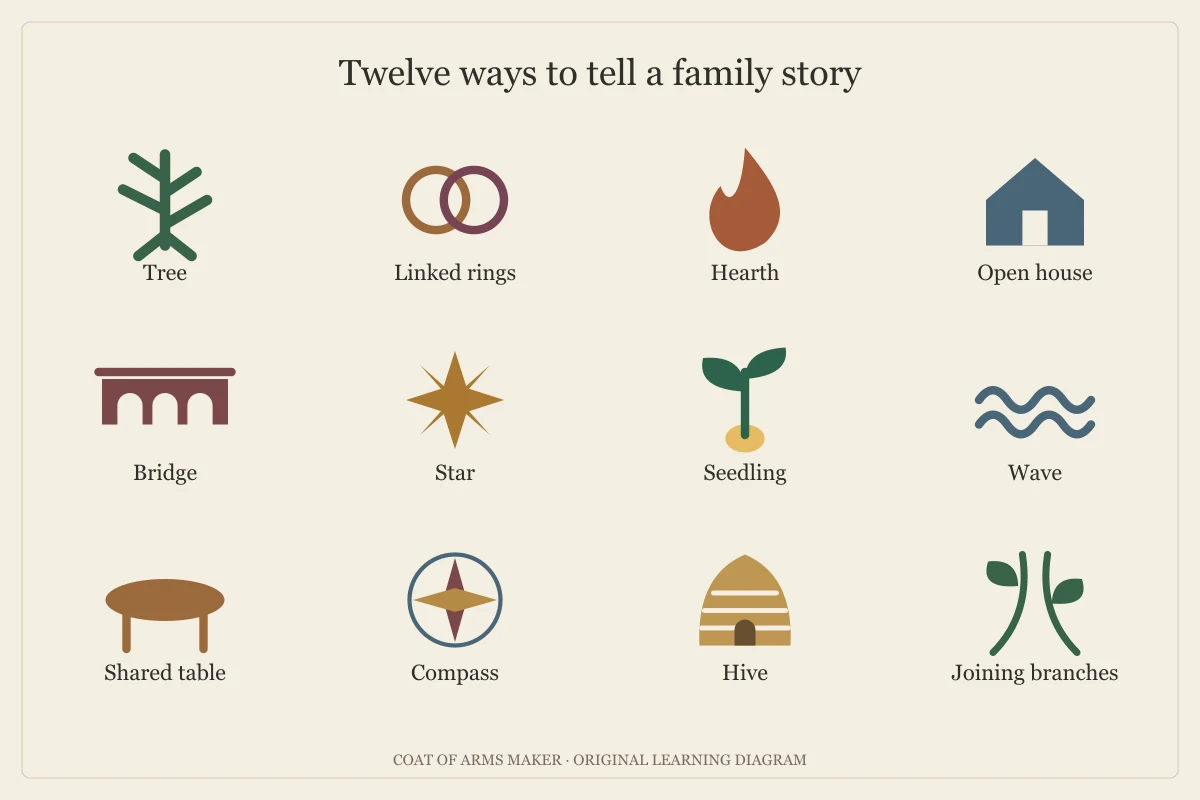
Choose family symbols around a shared relationship
Before collecting family symbols, finish this sentence: “We want this image to remind us of…” Answer with a concrete experience. Perhaps your grandparents kept a garden, your siblings live across an ocean, or your chosen family meets around the same kitchen table. A specific memory gives the design direction and makes it easier to decide what to leave out.
Agree on the audience as well. A reunion badge needs to be recognizable across generations. A private keepsake can carry a more personal reference. Family symbols for a school project should let children describe the people who care for them without requiring a particular household structure. Do not make a biological family tree the only possible model of belonging.
Write three candidate meanings, then rank them. Connection, resilience, and welcome could all fit, but one should lead. Family symbols become hard to read when every value receives a separate icon. Choose a central image and let a color, arrangement, or short phrase carry the supporting idea.
Four family symbols from nature
1. A tree with visible roots. Trees work well when the story involves continuity and several generations. A broad canopy can suggest shelter; branching can suggest different lives connected through a common beginning. For your design, use three or four large branches instead of dozens of named leaves. Family symbols based on ancestry should leave room for adoption, remarriage, and relationships that do not fit a simple chart.
2. A seedling. A small plant can represent beginning again, caring for a new household, or raising something together. These are proposed personal meanings, not a universal code. Family symbols do not need to look ancient to be meaningful. A seedling is especially useful when a mature tree would imply a long documented lineage that is not part of your story.
3. A wave. Water can recall a coastal home, a shared journey, or relatives living on opposite shores. Keep the curve broad enough to survive a small print. Family symbols involving migration need context: a wave by itself could just mean the beach. Pair it with a phrase about staying connected, or explain the story on the back of a card.
4. Two branches growing toward one another. This composition can express two households joining while retaining their own identities. Unlike a tightly closed circle, it can leave an opening for future growth. When comparing family symbols for a wedding gift, ask both people which plants belong to their actual lives rather than assigning a plant solely from a surname.
Four family symbols about home and care
5. A house with an open doorway. A house is easy to recognize, but its meaning depends on the people using it. An open door can express welcome, while a shared roof can suggest mutual care. Avoid drawing a specific expensive home if the intended message is belonging. Family symbols should include relatives whose experience of home differs from yours.
6. A hearth or flame. A simple flame can recall warmth, gathering, or a person who made others feel safe. Keep the surrounding shape restrained so the image does not look like a fire-service badge. Of these family symbols, the hearth often needs a caption to distinguish emotional warmth from a literal occupation or religious reference.
7. A shared table. This is a strong choice for a family whose connection lives in meals, storytelling, or hospitality. Draw the tabletop and a few open seats without trying to portray every person. Family symbols based on everyday objects can feel more specific than a conventional heart, particularly when the object has a recognizable story behind it.
8. A beehive. A hive can suggest coordinated work and a place maintained together. That is a modern design interpretation for this exercise. Ask whether the association feels caring or overly focused on productivity. Family symbols work through agreement, so a clever metaphor is not enough if several relatives find it uncomfortable.
Four family symbols about connection and direction
9. Linked rings. Two or three overlapping rings offer a compact expression of connection. They are easy to embroider and adapt to a badge, although they can resemble wedding or organizational marks. Family symbols made from rings benefit from a distinctive arrangement. Avoid copying a recognizable existing logo or adding so many rings that the overlap becomes visual noise.
10. A bridge. A bridge can represent maintaining relationships across distance, helping each other through a change, or a literal place where the family gathers. Make the arch and supports clear. Among these family symbols, a bridge is particularly useful for a blended family because its meaning can emphasize an ongoing connection without erasing separate histories.
11. A star. A single star can recall guidance, a shared destination, or a particular person. Stars also appear in national, religious, military, and commercial imagery, so context matters. Family symbols using a star should be evaluated in their complete arrangement. Point count, surrounding colors, and nearby objects may create an association you did not intend.
12. A compass. A simplified compass can express returning to one another despite different paths. Use four directions rather than a detailed navigation instrument. Family symbols for travelers are stronger when they refer to an actual shared practice: a regular gathering, an annual journey, or a promise to stay in contact. The explanation should be more personal than “we like adventure.”
Compare family symbols before drawing a crest
Test three family symbols against the same questions: Can everyone explain the connection? Does the silhouette remain clear at thumbnail size? Could someone reasonably mistake it for a different message? Will the design still fit the family after a move, a new relationship, or another child? There is no numerical score that replaces a conversation, but these questions expose useful tradeoffs.
For a reunion, a table might beat a tree because the event celebrates people gathering now. For a keepsake remembering a gardener, the seedling may be more specific than a heart. For relatives spread across countries, a bridge may communicate the desired relationship more clearly than a map. Family symbols should follow the story rather than force the story to fit an attractive illustration.
Try a short caption under each sketch of your family symbols. “A place for everyone” supports a table; “Across every distance” supports a bridge. If the caption has to explain five unrelated objects, simplify the image. Good family symbols can hold a rich story without displaying every detail of it.
Check cultural context before borrowing a traditional sign
Search results often present knots, characters, tattoos, and sacred motifs as interchangeable family symbols. Treat that claim as a starting question, not evidence. Find who uses the sign, where it appears, and whether the proposed meaning is supported by a reliable cultural source. A modern jewelry description alone cannot establish an ancient tradition.
If a design belongs to your own heritage, ask knowledgeable relatives or community sources about appropriate use. If it does not, consider an original object from your own experience instead. Family symbols can be expressive without borrowing a mark whose history you cannot explain. Do not combine unrelated traditions simply because their shapes look harmonious.
A genogram serves a different purpose: it records relationships using an explicit notation system. A decorative emblem communicates a story through visual association. Keep those purposes separate. Similarly, family symbols chosen today do not prove descent from the historical bearer of a crest found in a surname search.
Worked example: a family connected by Sunday calls
Imagine relatives living in three cities who speak every Sunday. They consider a globe, three portraits, and a bridge. The globe emphasizes geography but loses the personal detail. Portraits would be difficult to read on a small card. They choose a bridge with three simple openings, assigning those openings a meaning within their own design.
Their brief reads: “Create an original household emblem with one ivory bridge on a deep blue field. Use three broad arches, a simple silhouette, generous space, and no crowns or historic claims. Keep lettering separate.” This is a contemporary interpretation of family symbols, not a historical blazon. The family can adjust the arches if the grouping changes.
Before using the result, they show a small monochrome version to everyone involved. If the bridge looks like a fence, they widen the arches. If three arches imply that only three people belong, they explain the choice or remove the count. Family symbols should support the relationship rather than accidentally define who is excluded.
Adapt family symbols to their final use
For a printed invitation, include a brief explanation beside the emblem. For embroidery, remove fine lines and test the stitch size. For engraving, ask the maker to check the artwork before ordering. Family symbols intended for tattoos require a conversation with the artist about scale and how details will remain legible; a tiny screen preview is not a physical proof.
Keep an editable master and a plain version without lettering. Record the chosen story in a few sentences so relatives do not later mistake invented symbolism for historical fact. Family symbols can become a meaningful tradition through repeated, honest use. They do not need a fabricated medieval origin.
Questions & answers
What is the best symbol for family?
The best choice connects to a shared experience. A tree suits continuity, a table suits gathering, and a bridge suits connection across distance. Compare those family symbols with an object from your own household before choosing a generic image.
What symbolizes family and strength?
A rooted tree or a broad bridge can communicate resilience in a personal design. Explain what strength means to you: supporting someone, rebuilding together, or maintaining a relationship. Family symbols do not have fixed meanings that apply equally to every culture.
Can these symbols represent chosen family?
Yes. A shared table, open doorway, or linked rings can express belonging without suggesting biological descent. Let the people represented participate in the decision, and avoid counting branches or seats in a way that accidentally excludes someone.
Are family symbols the same as a family crest?
No. A chosen symbol is a design element. In heraldic terminology a crest is the element above the helmet in a fuller display. Modern family symbols can inspire an original decorative emblem, but they do not establish inherited arms.
Continue learning
- Turn a family story into an original crest
- Write a short family motto
- Research historical arms with evidence
Design an original family emblem — Use your chosen story and symbol as a brief for a new decorative design.
Sources & further reading
- LoveToKnow: types of family symbols
- The Irish Road Trip: context and caveats for Celtic family symbols
- Canva: genograms as relationship diagrams
The examples and illustrations in this guide are original educational designs. They do not document grants of arms or establish anyone’s ancestry.